LLC and TaxesTwo records have to agree
Steven Palmieri, Tax CFO and the Entrepreneur's CFO, keeps the books and prepares the return from a month that already closed.
The company begins on the day a state accepts the formation paper. How that company is taxed is a second choice, and it shows up on a return.
Wage accounts are opened in this practice, and the service you already picked keeps issuing the payments. Statements wait until the bank and the books already agree.
Start with the papersName both records
Say what you formed, and which return you filed last.

You will be talking to the Steven Palmieri practice.
The Tax CFO way
The return counts the year that already closed. The Tax CFO way chooses the classification while this year can still change.
The month you form
The certificate creates a company. It does not choose the return.
Click to read the formation month ›Tap to read the formation month ›The name at the bank
Deposits need an account that can carry the company's own name.
Click to see the account title ›Tap to see the account title ›
The return on file
The last return is the classification in force, whatever a group chat prefers.
Photograph by Geraldshields11, Creative Commons Attribution ShareAlike 4.0.
Click to see the filed return ›Tap to see the filed return ›The month you hire
Paying a person adds withholding the certificate never mentioned.
Click to read the first hire ›Tap to read the first hire ›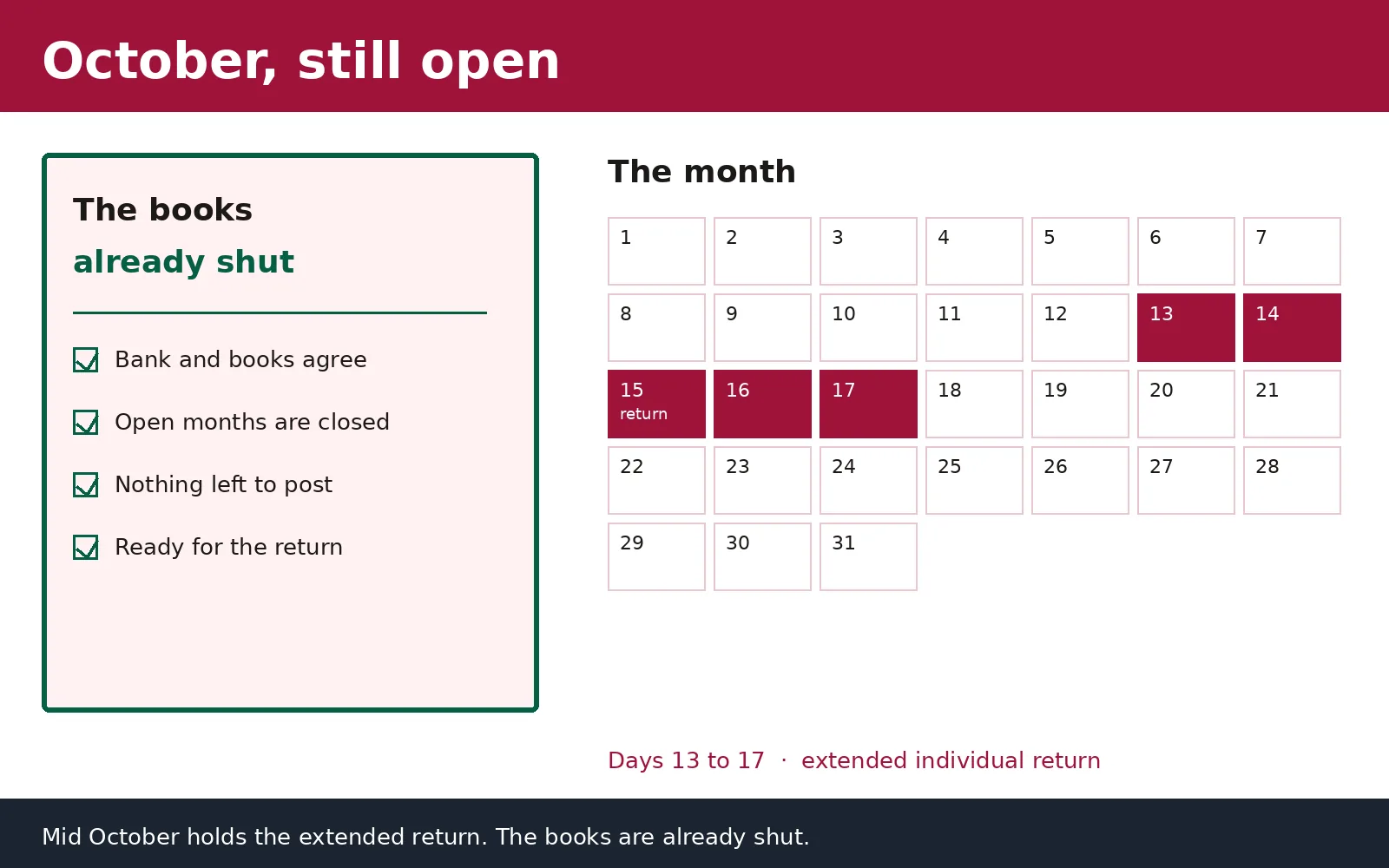
October, still open
An extended individual return lands in mid October, and the books should already be shut.
Click to read the October check ›Tap to read the October check ›When a notice arrives
A letter usually means a name, a number, or a form did not match.
Click to read the notice page ›Tap to read the notice page ›Six jobs across three bands
Open a job. The note says whether it belongs with the year, the month, or the daily records.
The year choice
1The classification
This job sits with the person who can still change how the year is taxed.
One owner usually lands on the individual return unless a later election was accepted. More than one owner usually lands on a partnership return. The band is the choice, not the certificate.
2A saving someone quoted
This job sits with the person who can refuse a saving that has no wage behind it.
A quoted saving is not a plan until wages, the cost of running payroll, and the owner's basis are on the same page. We do not print a dollar figure for a stranger's year.
The closed month
1The month that closed
This job sits with the person who refuses to file from an open month.
We prepare the return from a month where the cash figure and the bank already tell the same story. An open month is still a draft, and a draft is a poor place to lock a classification.
2October, year still open
This job sits with the person who uses October while the year can still move.
An extended individual return is due in the middle of October. That is also late enough in the year to see whether the classification still fits before December.
The daily records
1The name at the bank
This job sits with the person who keeps the company and the return in the same story.
Deposits should land in an account titled in the company's legal name. A personal account full of company receipts is how the two records start to argue.
2Payday after setup
This job sits with the person who puts payday in the month it happened.
We set the payroll accounts up with a provider you run. We do not run payday. The first hire is what makes that setup matter.
Steven Palmieri, Tax CFO.
The Entrepreneur's CFO. The company, the books, and the return are read in one practice.
Click to meet the Tax CFO ›Tap to meet the Tax CFO ›Send the two papers
The certificate, the last return, or a note that one of them is missing.
You will be talking to the Steven Palmieri practice.
Where the two records come apart
People treat the company and the tax as one object, and for a while nothing breaks. Then a return arrives that describes a business the owner does not quite recognize. The certificate and the tax life have been drifting.
Forming the company is a filing with a state. You paid a fee. A legal person now exists, or a single owner is holding a company the state will recognize. None of that filing told the federal government how to tax the activity.
The federal choice is often made by silence. A single member who never filed a choice generally reports the profit on a personal return. Several members who stayed silent generally file Form 1065 and hand each member a K-1. An S election is a later letter, accepted or not.
The drift shows up when someone is hired, when a second owner arrives, or when real money starts to move out. Those are the months worth reading before the year is over, not after the return is already in.
What a reading actually returns
Send the certificate if you have it, the last return if you filed one, and the name on the bank account. What comes back is a short note in ordinary words. It says what appears to be on file, what that means for the next return, and the one move that still fits before December.
No dollar saving is printed in this reel. A classification change can lower one tax and raise another, and the wage an owner must take if the company is taxed as an S corporation is part of that arithmetic. The arithmetic needs the year, not a slogan.
If the honest answer is that a quiet first year does not need a monthly arrangement, that is the answer. A return from a closed set of books may be the whole engagement. A weekly movement of money, or a person on payday, is when the month starts to earn its keep.
A lender who wants a signed audit, review, or compilation has to take that request to a firm that does that work. Before the conversation turns to months and filings, that boundary is said out loud. After it, this practice still keeps the monthly record, opens the payroll accounts, prepares statements from a closed month, and files the return.
A shape, with no name on it
Picture two people who formed a company in January and agreed out loud on a split. Nobody filed a federal election. By autumn the verbal split and the papers do not match, because there are no papers that describe the split. The month is still open, so the records can still be made to tell one story.
The two people are invented. No amount of money is attached, because an amount would pretend the shape was a result. Sequence is the idea the whole reel is built on. The company exists. The tax life was never chosen on purpose. The bank may be in one person's name. October is late enough to notice and early enough to fix the open months.
Everything published here comes back to that sequence. The pages below each take one moment in it. The formation month. The bank title. The return that was actually filed. The first hire. The October look. The letter that says something tore. None of them requires you to know the vocabulary before you start.